Wandering the Rim: Where Landmarks Meet the Wild at the Grand Canyon
You know that feeling when nature hits you like a truck? Yeah, the Grand Canyon did that to me. But beyond the cliffs and colors, I couldn’t stop noticing how human touches—those quiet, bold, or brilliant landmark buildings—shape the way we experience this wild wonder. From desert-sculpted lookouts to sky-high walkways, these structures don’t just stand out—they belong. This is wandering with purpose, where architecture and awe walk hand in hand.
First Glimpse: The Moment the Canyon Takes Your Breath
Stepping onto the South Rim for the first time is not just a visual experience—it is a full-body revelation. The air is crisp, carrying the faint scent of piñon pine and sun-warmed stone. As you approach the edge, the ground seems to vanish beneath you, opening into a chasm so vast it defies comprehension. Layers of red, ochre, and rust-colored rock stretch for miles, carved by time and the relentless flow of the Colorado River. The silence is deep, broken only by the distant cry of a raven or the soft rustle of wind through sagebrush. It is a moment suspended outside of time, where human scale dissolves into geological grandeur.
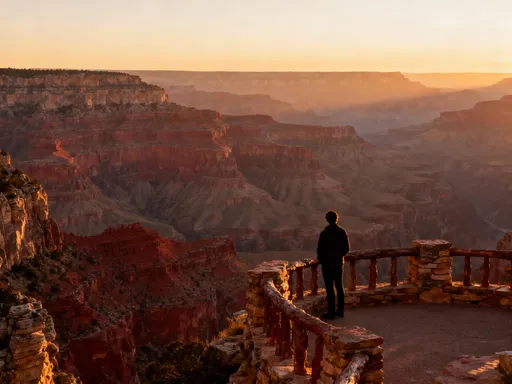
Yet even in this raw wilderness, human presence is quietly evident. The first structure many visitors encounter is the Mather Point Overlook, a simple but thoughtfully designed platform with low stone railings and interpretive signage. It does not shout for attention. Instead, it frames the view, offering a safe and accessible vantage point without competing with the landscape. This balance—between access and reverence—is at the heart of the Grand Canyon’s design philosophy. The buildings here are not afterthoughts; they are carefully placed companions to the natural drama, guiding visitors into deeper connection rather than distraction.
That first breathless moment is not accidental. It is the result of decades of planning, conservation, and architectural intention. The National Park Service has long understood that how people arrive at and move through the canyon shapes their emotional and intellectual response. The journey from parking lot to viewpoint is choreographed to build anticipation, culminating in that heart-stopping reveal. It is a masterclass in experiential design, where every path, bench, and railing serves a purpose beyond utility.
The Hidden Role of Design: How Buildings Shape Our Journey
At first glance, the Grand Canyon appears untouched by human hands. But a closer look reveals a network of structures that quietly shape the visitor experience. Trailheads are positioned to minimize environmental impact while maximizing visibility. Visitor centers are built low to the ground, using native stone and timber to blend into the landscape. Overlooks are spaced to allow for crowd management and contemplative solitude. These choices are not arbitrary; they reflect a deep philosophy of design known as the National Park Service Rustic style, or “parkitecture,” which emerged in the early 20th century.
This architectural approach emphasizes harmony with nature. Buildings are constructed with locally sourced materials—sandstone, ponderosa pine, and flagstone—so they appear to grow from the earth rather than be imposed upon it. Roofs are pitched to shed snow, eaves extend to provide shade, and windows are positioned to capture views while minimizing glare. The goal is not to hide human presence, but to make it feel like a natural extension of the environment. At the Grand Canyon Visitor Center, for example, the use of rough-hewn stone walls and exposed beams creates a sense of warmth and continuity with the surrounding forest.
When done well, this design language disappears into the background, allowing the canyon to remain the star. But when it fails—when a structure feels too large, too shiny, or too modern—it disrupts the sense of place. The contrast is instructive. A glass-and-steel building might offer panoramic views, but it can also create a barrier between visitor and landscape, turning awe into spectacle. The most successful designs at the Grand Canyon do the opposite: they dissolve the boundary, inviting people to feel part of the scene rather than separate from it.
Moreover, thoughtful placement of facilities supports conservation goals. By concentrating visitor activity in designated areas, the park protects fragile ecosystems elsewhere. Trails are routed to avoid erosion-prone zones, and rest stations are spaced to encourage hydration and reduce litter. These behind-the-scenes decisions are as important as the views themselves, ensuring that millions of annual visitors can experience the canyon without degrading it.
Skywalk Dreams and Desert Roots: Contrasting Architectural Styles
The Grand Canyon is not a single architectural experience, but a tapestry of styles shaped by different times, cultures, and intentions. Nowhere is this more evident than in the contrast between the South Rim’s historic lodges and the West Rim’s Grand Canyon Skywalk. On the South Rim, architecture speaks in whispers—low-slung buildings with stone foundations and wooden porches that seem to settle into the earth. On the West Rim, the Skywalk speaks in bold declarations: a horseshoe-shaped glass bridge extending 70 feet over the canyon’s edge, offering a transparent floor 4,000 feet above the river.
The Skywalk, opened in 2007 and operated by the Hualapai Tribe, represents a different vision of tourism—one centered on thrill, visibility, and economic opportunity. Constructed with 46,000 pounds of steel and 46 panes of laminated glass, it is an engineering marvel designed to deliver an adrenaline-filled perspective. Visitors often describe the sensation of standing on air, with nothing but clear glass between them and the abyss. It is an unforgettable experience, but one that divides opinion. Some see it as a modern wonder; others view it as an intrusion on sacred land.
In contrast, the South Rim’s buildings reflect a quieter, more contemplative ideal. El Tovar, built in 1905, resembles a Swiss chalet with its log walls, stone fireplace, and gabled roof. It was designed to feel like a wilderness retreat, a place where travelers could rest in comfort without losing touch with nature. Bright Angel Lodge, completed in 1935, carries forward this tradition with its rustic cabins, central courtyard, and handcrafted furnishings. These structures were built to last, not to impress. Their beauty lies in their simplicity and their ability to disappear into the landscape.
The difference between these two styles reflects broader questions about how we engage with natural wonders. Is the goal to conquer the view, to stand above it and claim it? Or is it to enter into relationship with it, to listen and learn? The Skywalk offers one answer; the South Rim lodges offer another. Both have their place, but they invite different kinds of attention. One commands the gaze; the other invites reflection.
Hopi Point to Yavapai: Landmark Viewpoints That Tell a Story
Each overlook along the South Rim offers a unique perspective, not just of the canyon, but of human interaction with it. Hopi Point, at sunset, is legendary for its panoramic views of the Inner Gorge. The low stone wall that edges the precipice is more than a safety feature—it is a subtle invitation to pause, to lean in, and to take in the layers of time revealed in the rock. Interpretive plaques, carved into stone or mounted on bronze, explain the geological history, naming formations like the Vishnu Schist and the Coconino Sandstone. These details transform a beautiful view into a story.
Yavapai Point, home to the Yavapai Geology Museum, takes this educational role further. Housed in a 1928 building of native stone and timber, the museum features large windows that frame the canyon like a living diorama. Inside, exhibits explain how the Colorado River carved the canyon over six million years, with diagrams, rock samples, and interactive displays. The building itself is part of the lesson: its thick walls regulate temperature naturally, and its low profile ensures it does not obstruct the view. Here, architecture and science work together to deepen understanding.
Other viewpoints, like Lipan Point and Moran Point, are less crowded but equally powerful. Their designs follow the same principles: minimal railings, shaded shelters, and benches positioned for optimal viewing. These structures are not ornamental. They are functional elements of a larger system designed to manage visitor flow, protect sensitive areas, and enhance safety. At dawn or dusk, when the light paints the cliffs in gold and violet, these overlooks become quiet sanctuaries, where the only sound is the wind and the occasional whisper of awe.
Accessibility is also a key consideration. Many overlooks are reachable via paved paths, allowing visitors with mobility challenges to experience the canyon’s grandeur. Ramps, tactile maps, and audio guides ensure that the wonder is shared widely. This inclusivity is not an afterthought—it is central to the park’s mission. The Grand Canyon belongs to everyone, and its design reflects that belief.
Staying Within the Wild: Lodges That Feel Like Part of the Landscape
Spending the night at the Grand Canyon is more than a convenience—it is an extension of the experience. The historic lodges along the South Rim are not hotels in the conventional sense. They are destinations in their own right, designed to immerse guests in the rhythm of the canyon. El Tovar, often called the crown jewel of Grand Canyon architecture, sets the standard. Its great hall features a massive stone fireplace, hand-carved wooden beams, and windows that open to sweeping views. Guests dine on locally inspired cuisine while listening to the soft strains of a piano in the background. It is luxury, but of a specific kind—one rooted in place and purpose.
Bright Angel Lodge, designed by architect Mary Colter, takes a more intimate approach. Its cluster of log cabins surrounds a central courtyard, creating a sense of community and shelter. The main building houses a registration desk, a small gift shop, and a lounge with a stone fireplace. Colter’s attention to detail is evident in every corner: the hand-woven Navajo rugs, the kachina doll displays, and the use of natural materials that echo the surrounding environment. Even the lighting is subdued, encouraging guests to slow down and tune into the natural world.
These lodges are not relics. They are living spaces, continuously maintained and updated to meet modern standards while preserving their historic character. Solar panels, energy-efficient windows, and water-saving fixtures have been integrated without compromising aesthetics. The goal is not to freeze them in time, but to ensure they remain functional and sustainable for future generations.
Staying in these lodges changes the way people experience the canyon. Without the need to rush back to distant accommodations, visitors can rise before dawn to watch the sunrise paint the cliffs, or linger after dark to stargaze under some of the darkest skies in the country. The lodges become a base for deeper exploration, a place to return to between hikes, talks, and quiet moments of reflection.
Behind the Scenes: Infrastructure You Don’t Notice (But Should)
While the views and lodges capture attention, the Grand Canyon’s functionality depends on infrastructure that most visitors never see. Water must be pumped from deep aquifers and distributed across the rim. Waste is carefully managed to prevent contamination. Trails are maintained by crews who repair erosion damage and clear fallen rocks. Shuttle buses run on clean-burning fuel, reducing traffic and emissions. These systems are not glamorous, but they are essential to the park’s survival.
The shuttle system, introduced in the 1990s, is a prime example of quiet innovation. By limiting private vehicle access to certain areas, the park has reduced congestion, noise, and air pollution. The buses stop at key viewpoints, lodges, and trailheads, making it easy for visitors to explore without a car. Real-time tracking and frequent service ensure reliability, while the use of hybrid and electric models supports sustainability goals. This system has transformed the visitor experience, making the canyon more accessible and less stressful.
Similarly, trailside rest stations provide shade, water, and emergency information. Built with the same rustic aesthetic as other park structures, they blend into the environment while serving a critical function. Rangers staff these stations during peak seasons, offering guidance and monitoring visitor safety. Their presence is reassuring, especially for hikers attempting challenging routes like the Bright Angel Trail or the South Kaibab.
Behind the scenes, park planners use data to anticipate visitor patterns and adjust services accordingly. Crowd modeling helps determine when to open additional shuttles or close viewpoints for maintenance. Weather monitoring informs trail conditions and safety alerts. These decisions may seem minor, but they ensure that the park remains safe, clean, and welcoming for all. Responsible tourism is not just about individual behavior—it is about systems that make good choices easy.
Wandering With Meaning: How to See the Canyon Through Its Structures
To truly appreciate the Grand Canyon, visitors must learn to see beyond the scenery. The buildings, pathways, and railings are not just functional—they are part of the story. A simple way to begin is by slowing down. Instead of rushing from overlook to overlook, spend time at one or two. Notice the materials used in the construction. Are the stones local? Do the railings curve to follow the natural contour of the land? Is there signage that explains the geology or cultural history?
Another practice is to follow the design cues. Many trails begin with a wide, paved path that gradually narrows into a dirt trail, signaling a transition from accessibility to wilderness. Benches are often placed at key viewpoints, inviting rest and reflection. These details are intentional, guiding not just movement but mindset. By paying attention, visitors can become more mindful travelers, attuned to the care that goes into preserving the park.
Families, in particular, can use these structures as teaching tools. Children respond well to hands-on learning, and the interpretive displays at Yavapai or the Geology Museum offer engaging ways to explore science and history. Parents can ask questions: “How old do you think this rock is?” or “Why do you think they built the railing this way?” These conversations deepen connection and make the experience more memorable.
Finally, choosing to use the shuttle, stay in historic lodges, or follow Leave No Trace principles is a way of honoring the park’s legacy. Every decision, from where to eat to how to dispose of trash, has an impact. The most meaningful visits are those in which travelers see themselves not as spectators, but as stewards.
As the sun sets and the canyon glows in amber light, the structures along the rim take on a new presence. They are no longer just buildings, but companions on a journey. They have sheltered millions of visitors, framed countless sunrises, and stood as quiet witnesses to the enduring power of nature. To wander the rim is to walk through a carefully composed landscape, where every stone, beam, and railing has a role to play.
The real journey begins when we see both rock and railing as part of the same story. The Grand Canyon is not just a place to visit. It is a place to understand—a testament to what happens when human ingenuity meets natural wonder with respect, care, and humility. In that balance, we find not just beauty, but meaning.